WRITTEN BRIEF ONLY
LinkScope Sourcing 05
The dialog elsewhere on the site is a narrow form. This page keeps the handling steps beside the same form so a buyer can see what happens after the wavelength packet is submitted.
How an optics brief moves
- You submit specification, quantity, destination, and timing.
- The desk checks whether wavelength, rate, reach class, connector, and host are complete enough to send outward.
- Factories that receive the packet answer on that basis. A swapped channel comes back labeled as a deviation.
- You compare the replies. The desk does not pick the factory.
Channels that are actually in use
- Written brief: the form on this page. That is the controlled channel.
- Reply path: the work email you type into the form. No separate mailbox is published here.
- Phone: not published. A call would skip the wavelength and host fields the comparison needs.
- Hours: briefs are read on US business days. A timestamp on the form is not a shipment promise.
- Social accounts: none are operated for quotations.
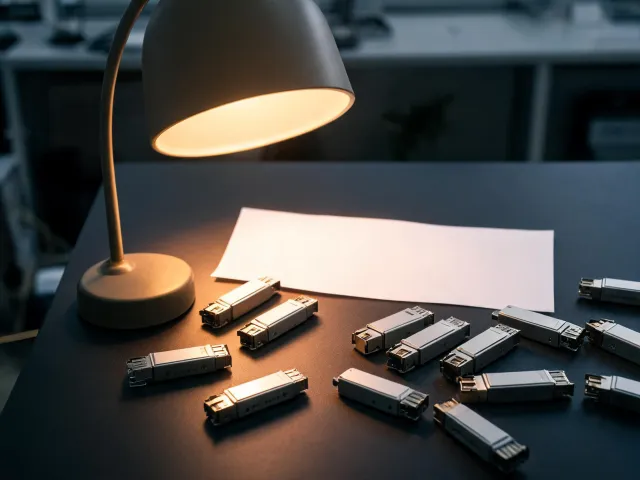
Do not treat a pin on a public map as this desk. The illustration shows a review bench for modules and a blank channel sheet, not a street address.
What to place next to the price question
Interface type, data rate, wavelength or ITU channel, fiber mode, reach, connector, optical budget, diagnostics, temperature range, and host platform. Quantity of modules. US destination. Expected timing.
Add power draw if the cage is near its watt limit, and the rack environment if the temperature window is industrial. A planning loss check is 0.22 dB/km times your kilometers. For an 80 km class question that is about 17.6 dB of fiber before the mux. Ask the factory for Tx and receiver sensitivity rather than accepting the word “80 km” alone.
An optional budget needs a currency and a basis: per module or the whole order. High-end, mid-range, budget, or undecided describes the kind of factory response you want. It is not a score this desk has verified, and you can send the brief before any factory has priced it. Keep a new module and a refurbished pull on separate lines: warranty months and any DOM hour note change the offer even when the wavelength matches. Single-mode C-band and multimode 850 nm do not share a price cell.
If a channel plan will not fit in the form, say so in the requirement field and send the file after the first reply. The form itself has no upload control. Reference questions gathered from public standards pages on 2026-10-27 do not replace the supplier datasheet for the exact model.
Useful numbers to type when you know them: nominal wavelength in nanometers, grid spacing in GHz, rate in Gbit/s, transmit power and receiver sensitivity in dBm, dispersion tolerance in ps/nm, and the temperature window in degrees Celsius. Leave a cell blank rather than guessing a channel.
If the path includes jumpers, state channel width as 100 GHz or 50 GHz, insertion loss you will allow per LC pair, and a return loss figure you want the factory to answer. Connector mating cycle life matters when one cord is reused in test. Ingress protection matters only for a cabinet in the weather. Name the host rack unit. A planning wavelength of 1550.12 nm sits near 193.4 THz. Ask which measurement accuracy and which calibration traceability cover the dBm columns. Those requests are questions, not readings from this desk.