Channel
ITU grid spacing, nominal wavelength in nm, and the mux slot the buyer already owns. Adjacent channels are not substitutes unless the filter plan says so.
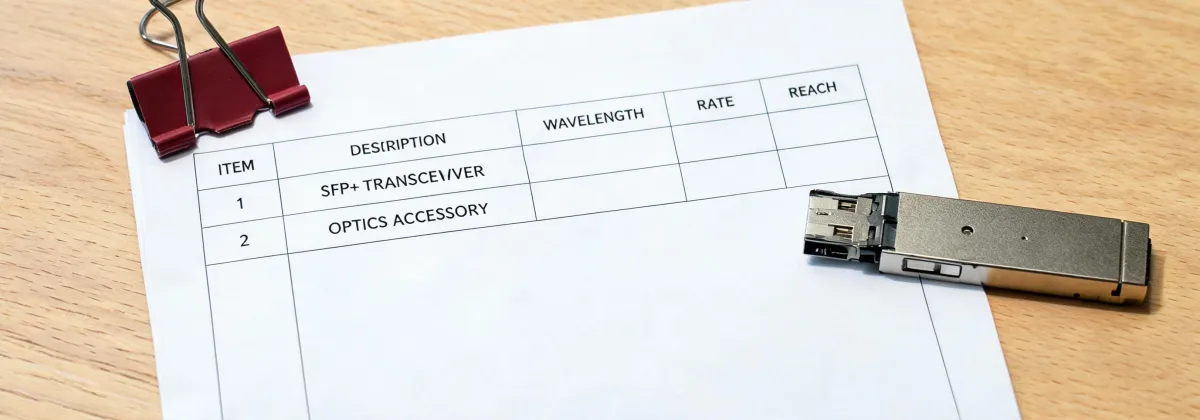
QUOTATION FIELDS · 80 KM CLASS
A dwdm sfp 10g 80km factory reply is usable when every supplier fills the same rows. The console below is the packet the desk sends outward. It is not a claim that a plant has already built the part, and it is not a measured link from this office.
ITU grid spacing, nominal wavelength in nm, and the mux slot the buyer already owns. Adjacent channels are not substitutes unless the filter plan says so.
10.3125 Gbit/s Ethernet, 9.95 Gbit/s SDH/SONET, or another line rate, plus SFP+ mechanical fit and host power budget in watts.
Minimum Tx power, maximum Tx power, and receiver sensitivity, all in dBm, plus the dispersion tolerance in ps/nm. The 80 km word is the class name, not the proof.
Leave a cell blank when you do not know it. A guessed wavelength creates a quotation you cannot install.
| Row | What to request | Why the quotes diverge |
|---|---|---|
| Fiber | Single-mode, usually G.652, and the measured span loss if you have it | A multimode 850 nm offer answers a different plant |
| Loss stack | Fiber attenuation, mux insertion loss, connector pairs, splices, and margin | Module optical budget does not include the mux |
| Worked check | 0.22 dB/km × 80 km = 17.6 dB of fiber, before about 1 dB of connectors and any splice | A module with 14 dB budget cannot cover that stack |
| Dispersion | About 17 ps/nm/km × 80 km ≈ 1360 ps/nm on a typical G.652 question | Some 10G reaches need compensation that another quote excludes |
| Temperature | 0 to 70 °C or −40 to 85 °C, plus the rack airflow | An indoor commercial part is cheaper to build and wrong outdoors |
| Evidence | Current datasheet, DOM map, and any compliance file for that model | A family PDF does not bind the EEPROM you will receive |
| Commercial | Quantity, currency, per module or whole order, Incoterm, freight, duties | A unit rate without the lane is not a total |
Exclusions to force into the open: dispersion compensation modules, the mux or demux, LC jumpers, host coding labor, software licenses, spares, and commissioning. If a supplier folds one of those into the module rate, the comparison column has to say so. Also request return loss on any jumper in the price, channel width on the grid (100 GHz or 50 GHz), and connector mating cycle life if one cord will be retested. Measurement accuracy of the power meter and calibration traceability of that meter stay on the supplier sheet. The desk does not invent a landed percentage and does not treat a target budget as a price the factory has accepted.
Supplier preference, when you state one, is high-end, mid-range, budget, or still undecided. That word describes the replies you want to see. It is not a rating this desk has verified, and you can send the packet before any factory has priced it.
Some platforms check vendor identification bytes and shut the port when the bytes do not match a supported list. Ask whether the quote is OEM-coded for your software release or a generic MSA identity. A lab note from a different chassis does not transfer. Record the host name in the brief so the factory answers that cage, not a similar one.
A datasheet reach of 80 km is often calculated on fiber loss alone, with a stated dispersion and a stated penalty. Your mux may add several decibels of insertion loss, and a dirty LC pair adds more. Subtract receiver sensitivity from minimum transmit power, then compare that difference with fiber plus mux plus connectors plus the margin your operations team requires. If the supplier reach assumes a dispersion compensating fiber that you do not have, mark the quote as incomplete.
A 10G Ethernet module and a SONET/SDH module can share an SFP+ shell and still fail the line code. Write the service. If the span is an OTN handoff, say so. Do not accept a wavelength match as a protocol match.
The inquiry cards are the labels. The form carries the filled rows. A longer checklist sits in the buyer note.
Describe the bill of materials in the requirement field: one row per wavelength, with rate, reach class, connector, quantity, and host. If a spreadsheet will not fit, say that a file will follow the first reply. The form has no attachment control, and a missing file does not pause the written rows.
Factories answer that text. Deviations should come back as deviations, not as a silent swap of wavelength or temperature grade.
QUALIFIED BUSINESS BUYERS
Compare quotations from up to 3 factories after the DWDM module specification is written down.
Eligibility applies to qualified business buyers and is confirmed after we review your product, quantity, destination, and sourcing requirements.