COMPACT HANDOFF
dwdm sfp 10g 80km wholesale
Use this page when a dwdm sfp 10g 80km wholesale comparison must fit on one sheet. Fill the open cells. Do not borrow a channel from a previous order to make the sheet look finished.
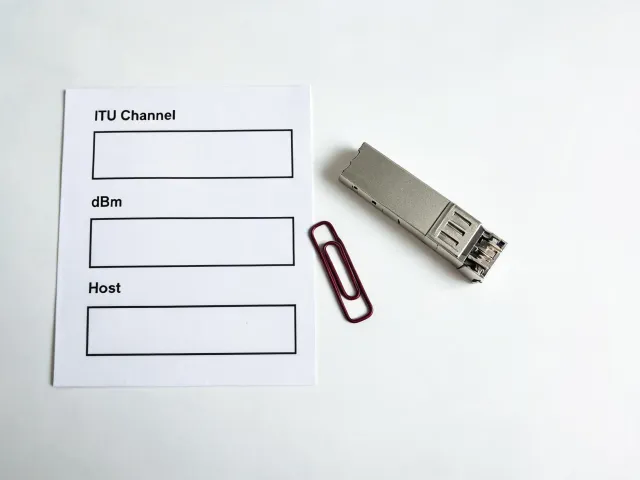
Cells to close before an alternate is accepted
- Interface and rate. SFP+ cage, and the service rate: about 10.3125 Gbit/s for 10 Gigabit Ethernet or about 9.95 Gbit/s for STM-64/OC-192. Write OTU2 only if that is the handoff.
- Wavelength. Grid 100 GHz or 50 GHz, nominal nm, and the mux channel number you already use. A sample prompt is 1550.12 nm. It is not a default shipment.
- Fiber mode. Single-mode. If someone offers multimode, stop and move that offer to a different purchase. OM4 at 850 nm is a short-reach discussion, commonly a few hundred meters, not an 80 km DWDM discussion.
- Reach class versus your loss. Planning fiber loss of 0.22 dB/km across 80 km is 17.6 dB before connectors and the mux. Ask for Tx minimum and receiver sensitivity in dBm. Optical budget is their difference. If it is 14 dB and your stack is 17.6 dB plus mux, the wholesale price is for a module that does not clear the span.
- Dispersion. Ask for tolerance in ps/nm. A G.652 planning figure near 17 ps/nm/km times 80 km is about 1360 ps/nm. If the sheet is silent, the alternate is not ready.
- Connector, DOM, temperature. LC duplex unless the plant says otherwise. DOM yes or no. Temperature window 0 to 70 °C or −40 to 85 °C. Power draw in watts if the cage budget is tight.
- Host. Chassis, line card, and software release. State OEM-coded or generic MSA as the request, not as a result. The supplier must say which EEPROM the quote includes.
- Commercial basis. Quantity, currency, per module or whole order, destination, timing, and whether freight and duties are inside the figure. High-end, mid-range, budget, or undecided is a preference, not a grade.
Condition is its own cell. New and refurbished do not average. For a pull, ask for warranty months and any available DOM hour or case note. A lower unit rate on an unknown pull is not a completed comparison.
Checks before you accept a substitute
- Same shell, different wavelength
- Reject it unless your mux channel plan lists that nanometer. A 0.8 nm neighbor on a 100 GHz grid is a different filter slot.
- Same wavelength, different dispersion note
- Reject it for an 80 km class span when the tolerance is missing or when the quote assumes a compensator priced at zero. Compensation is a separate device with its own insertion loss.
- Same datasheet headline, different EEPROM
- Hold the order until the supplier writes the host policy. Compatible coding can be the right commercial choice and can still be blocked by the switch. OEM coding can match a support policy and can miss your lead time. Neither outcome is known until the bytes and the software release are named.
- Same price, different temperature
- A commercial 0 to 70 °C part is not a substitute for an industrial window if the cabinet crosses those limits. The wholesale comparison has to keep the grade visible.
Standards language is a source of questions. The public ITU fibre recommendation entry, looked up on 2026-10-27, does not approve a wholesale lot. Exact-item evidence is the datasheet, the test basis the supplier will actually provide, and your incoming check of wavelength and DOM if you choose to run one.
Labels live on the product cards. The filled sheet goes through the form.
Hand off the sheet
Paste the closed cells into the requirement field. Leave unknown cells marked unknown. The desk will not fill a wavelength for you in order to make three factories answer faster.